Attic ventilation and radiant barrier for Conroe's 150-degree attics
On a July afternoon a Conroe attic hits 140 to 160 degrees. That heat cooks the shingles from below, soaks into the ceiling, and runs the AC all night. Ridge vents, real intake, solar fans and radiant barrier fix it.
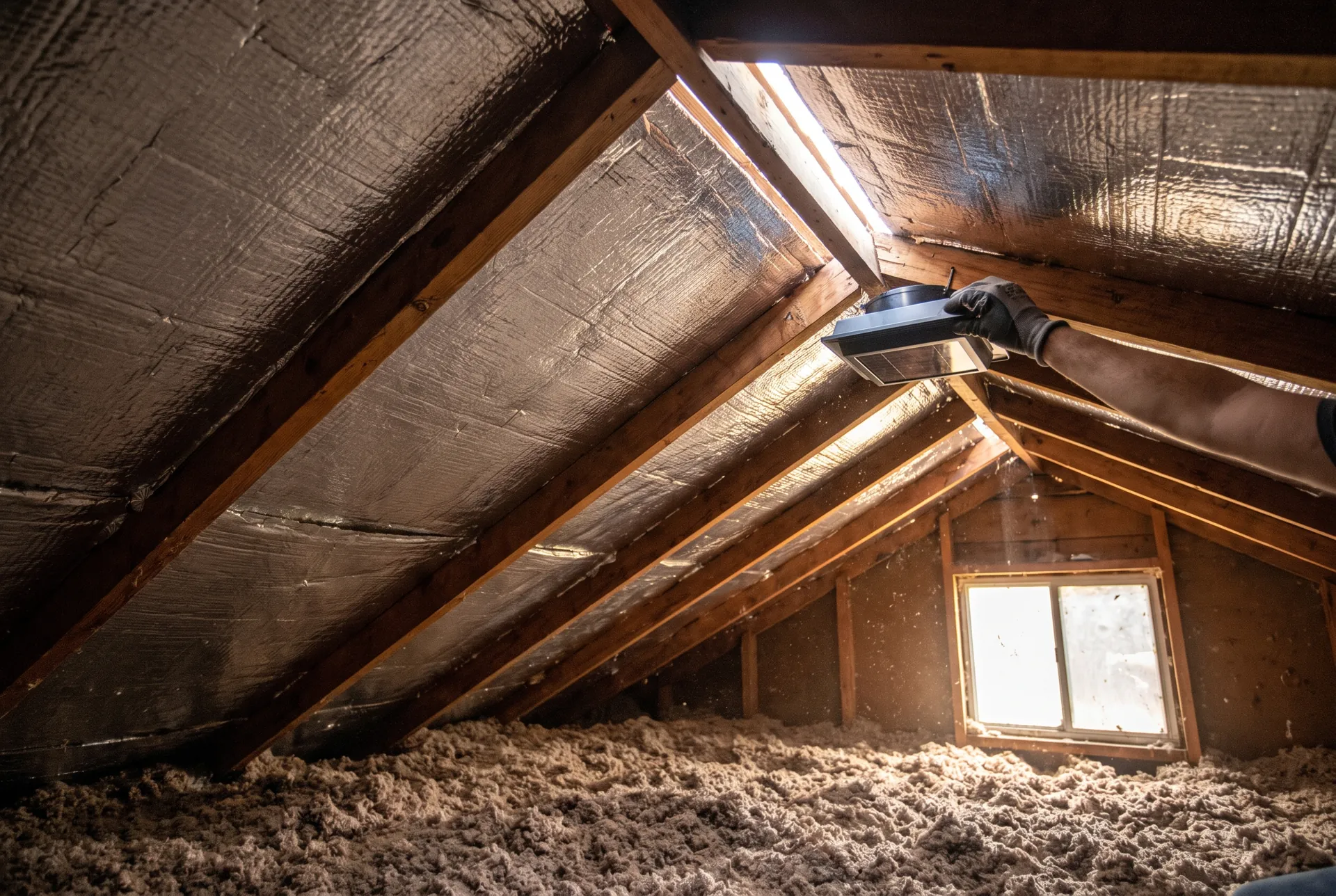
Ask a Conroe roofer why a 30-year shingle lasted 15 and the honest answer is usually the attic. When the attic can't move air, summer heat builds to 150 degrees and stays there past midnight; the asphalt in the shingle bakes, the granules let go, the shingle curls, and the whole roof ages twice as fast. The same heat pushes through the ceiling insulation and is a big part of why the upstairs bedrooms never cool down and why Entergy bills top $400 in August.
Ventilation is a system, not a vent. Hot air leaves at the top — a continuous ridge vent along the peak is the best exhaust there is, better than the box vents and turbines most 1990s and 2000s builders used — but only if cooler air can come in at the bottom, through soffit vents that aren't painted shut or buried in blown insulation. We cut in ridge vents, add or clear soffit intake, install baffles so the insulation doesn't block it, and where the roof shape won't allow enough passive venting, add a solar-powered attic fan that runs hardest exactly when the sun is hottest and costs nothing to operate.
Radiant barrier is the other half. New Conroe homes get it from the builder (the foil-faced decking you see in every Grand Central Park attic); older homes don't. A sprayed or stapled radiant barrier on the underside of the roof deck reflects most of the radiant heat before it reaches the insulation and typically drops attic temperatures 20 to 30 degrees. Together with proper venting, it's the cheapest thing you can do for a roof's lifespan and a summer electric bill — and it's a natural add-on when we're already replacing the roof.
What's included
Ridge vent
Continuous ridge vent cut into the peak with external baffles — the highest-capacity passive exhaust, invisible from the street.
Soffit intake & baffles
Soffit vents added or cleared, insulation baffles installed so air actually gets in at the eave.
Solar attic fans
Roof- or gable-mounted solar fans with thermostat control for roofs that can't vent passively; no wiring, no electric cost.
Radiant barrier
Spray-applied or stapled foil radiant barrier on the underside of the deck; reflects up to 95% of radiant heat.
Turbine & box-vent cleanup
Old turbines and box vents removed and decked over when a ridge vent replaces them, so the roof stops leaking at ten places.
Bath & kitchen exhaust
Bath fans and range hoods that dump into the attic (very common) re-ducted to the outside to stop the moisture.
Attic ventilation & radiant barrier cost in Conroe, TX
| Job | Typical price | Notes |
|---|---|---|
| Ridge vent cut into an existing roof | $650 – $1,500 | Includes capping over old box vents |
| Soffit intake vents added (per 10) | $450 – $900 | With insulation baffles |
| Solar attic fan, installed | $800 – $1,600 | Thermostat, 25–40 W panel |
| Radiant barrier, spray-applied | $1.50 – $2.50 per sq ft of attic | Typical attic $2,200 – $4,500 |
| Radiant barrier, stapled foil | $1.25 – $2.00 per sq ft | Best done with the roof off or on open rafters |
| Bath fan re-ducted to the exterior | $250 – $450 each | Stops attic condensation |
| Ventilation package with a new roof | $900 – $2,200 | Ridge vent + intake + baffles |
These are 2026 Montgomery County ranges so you can budget. Your written price is itemized — tear-off, decking allowance, underlayment, shingles or panels, flashing, ventilation, haul-off — and good for 30 days.
Recent work
Questions we get about attic ventilation & radiant barrier
Will attic ventilation lower my electric bill?
Typically 10 to 20 percent off summer cooling when an attic goes from no real airflow to a balanced ridge-and-soffit system, and more with a radiant barrier added. The bigger benefit is the roof: a shingle over a 120-degree attic lasts years longer than one over a 155-degree attic.
Ridge vent or turbines?
Ridge vent. It moves more air, it doesn't rust, seize or squeal, and it doesn't leak the way old turbine bases do. When we install a ridge vent we remove the turbines and box vents and deck over the holes — mixing exhaust types short-circuits the airflow.
Do I need a powered fan?
Only if the roof can't vent passively — hip roofs with short ridges, roofs with no soffits, or complex roofs with dead pockets. A solar fan is the right kind when you do: it runs when the sun is on the roof and costs nothing to run.
Is radiant barrier worth it on an older home?
In Conroe, yes. It's the single biggest change to attic temperature short of spray-foaming the roof deck, it's a few thousand dollars, and it pays back in cooling costs in three to six years. It's also why new-construction attics here are foil-faced by default.
Can too much ventilation hurt?
Unbalanced ventilation can — more exhaust than intake pulls conditioned air out of the house through every ceiling gap. That's why we add intake before exhaust and size them together.
My bathroom fan blows into the attic. Is that a problem?
Yes, and it's common in Conroe homes built before 2010. Moist air in a hot attic condenses on the decking at night and grows mold on the north side. We re-duct it through the roof or soffit with a proper cap.